Talk Overview
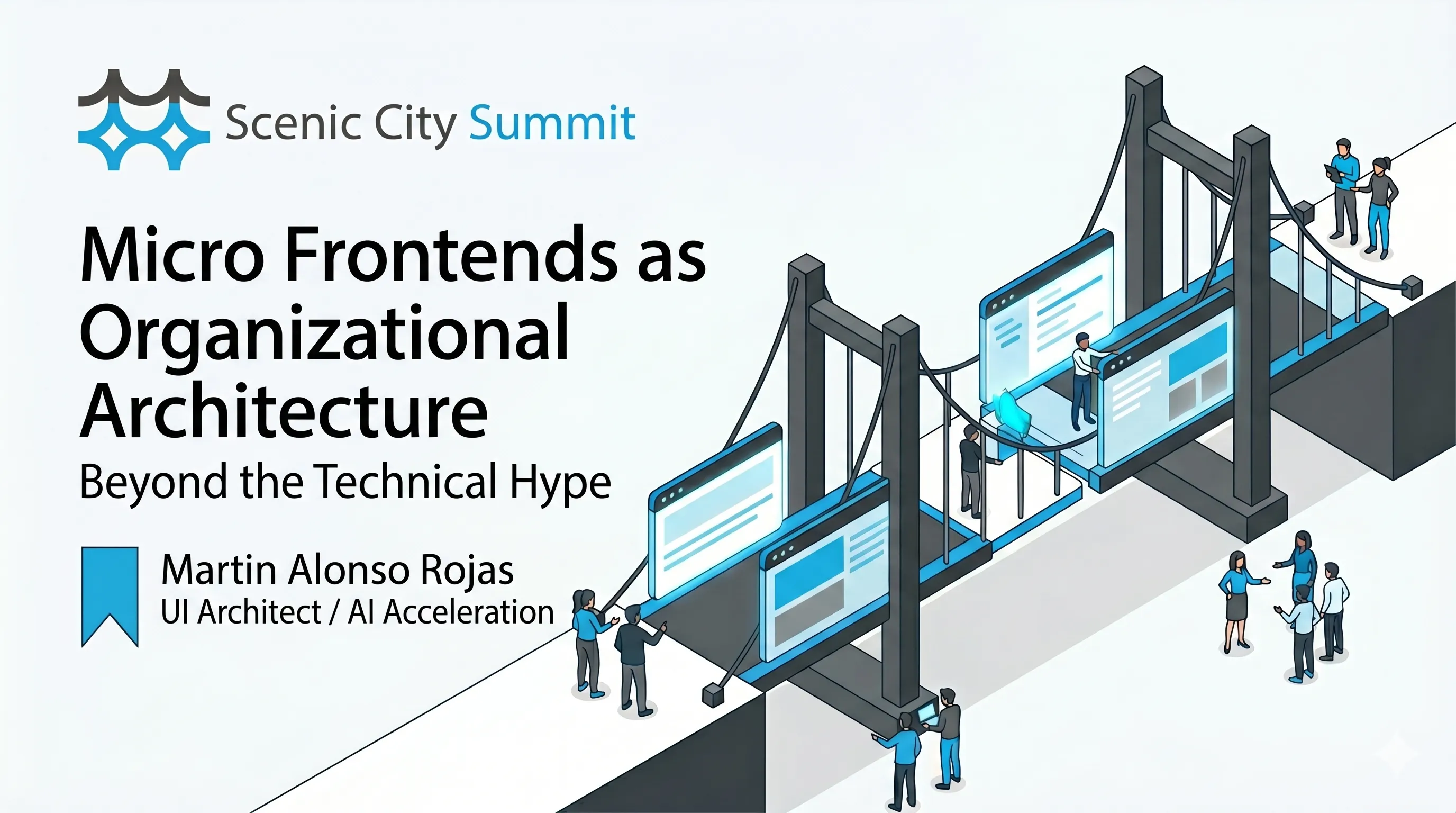
Micro frontends aren’t primarily a technical pattern — they’re an organizational one.
Most micro frontend discussions miss the point by focusing on implementation details rather than organizational structure. Drawing from experience managing frontend architecture serving 2+ million users across distributed teams, this talk demonstrates how to decompose applications using business-driven design principles that align with how your teams actually operate and deliver value.
Key Topics Covered
- Why Conway’s Law makes team structure the most important input to frontend architecture decisions
- The critical difference between domain-driven and business-driven decomposition strategies
- Organizational signals that indicate micro frontends might solve real problems — and red flags that suggest you’re solving the wrong problem
- The true cost of micro frontends beyond technical complexity: governance overhead, team cognitive load, and coordination tax
- A decision framework that balances technical architecture with team autonomy, product ownership boundaries, and business delivery needs
Learning Outcomes
Attendees will be able to:
- Assess organizational readiness for micro frontends by identifying specific team structure patterns and pain points that micro frontends actually solve
- Distinguish between business-driven and domain-driven decomposition strategies and select the approach that matches their organizational reality
- Evaluate the true cost of micro frontends beyond technical complexity — including organizational coordination, governance overhead, and team cognitive load
- Apply a decision framework that balances technical architecture with team autonomy, product ownership boundaries, and business delivery needs
- Recognize anti-patterns where micro frontends create more organizational friction than they resolve
Who Should Attend
Engineering leaders, frontend architects, and technical leads at organizations weighing whether to split a frontend — especially those in enterprise environments where team boundaries, budget constraints, and product ownership matter more than perfect technical domains.